

Boxes? Check. Packing tape? Check. Moving company booking confirmed? Check. Moving insurance secured? Um. Maybe that one's still pending. Don't fret if you haven't crossed "Get a moving insurance policy" off your moving day checklist, or if you didn't even write it on there! An often-forgotten part of relocating, purchasing moving insurance isn't as overwhelming as it might seem. And, with our guide, getting it gets even easier.
As an Austin moving company, we help clients understand their coverage options before moving day.
What is moving insurance?
A moving insurance policy protects your belongings while they're in transit from Point A to Point B, whether you take them there yourself or hire one of the top moving companies in Austin to do it.
Do I need moving insurance?
You're not required to get moving insurance, but it's never a bad idea. Homeowners insurance covers repair or replacement costs for items while they're at your address. However, many of these policies exclude any damage that occurs while they're in storage or transit. That said, it's better to be safe than sorry, especially if you're moving valuable or fragile items.
Types of moving insurance
There are three types of moving insurance to know before you book a mover. Released value protection and full value protection are mover-provided valuation coverage, not insurance policies. The third option, third-party liability coverage, is a separate policy you can purchase.
Federal law requires movers to offer released value protection and full value protection for interstate moves. Each state sets its own intrastate moving rules. In Texas, intrastate moves are regulated by the Texas Department of Motor Vehicles. You and your mover agree on the mover’s liability in the moving services contract; ask about valuation and transit insurance options before signing.
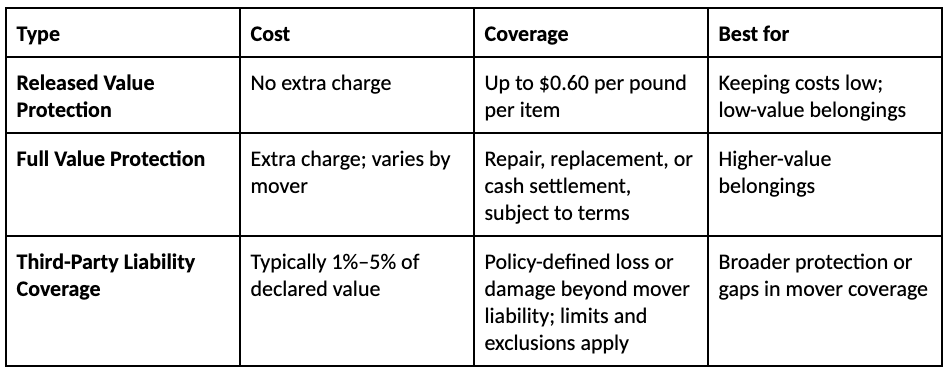
Released Value Protection
Often called basic carrier liability, released value coverage is free. Coverage is determined not by your items' actual values, but by their weight, paying up to 60 cents per pound. For example, if your 100-pound hutch gets broken in transit, the moving company is only liable for $60. Released value protection can be helpful if you're seeking coverage for as low a price as possible. However, if you have lots of lightweight but high-value items, it won't do much for you if they get damaged.
Full Value Protection
Like released value protection, federal law mandates that moving companies must offer full value protection for interstate moves. But unlike released value protection (RVP), this coverage costs extra.
Under full value protection, the movers are responsible for replacing any of your lost or damaged goods. They reserve the right to decide how they'll do it, choosing to repair it, replace it with a similar item, or make a cash settlement for repair costs or current market replacement value. They can also limit their responsibility to loss or damage of items valued more than $100 per pound unless you specifically declare them in advance.
Third-Party Liability Coverage
You can purchase third-party liability insurance through select moving companies or through an insurance agency of your choice. Going the third-party route usually means getting more coverage than you'd get from your mover's RVP and FVP options, as some of these policies can protect your things from events beyond anyone's control, including acts of God and natural disasters.
With third-party insurance, the mover is still responsible for up to 60 cents per pound per item. The insurance company may cover the remaining loss, subject to the policy’s deductible, limits, and exclusions. Third-party policies typically cost between 1% and 5% of the declared value of your belongings, depending on deductible and coverage limits.
When additional coverage may make sense
You may think the free moving insurance option is obviously the smartest choice. And, in some cases, it is. But other times, additional coverage is the safest bet. You might want to purchase FVP or third-party insurance if:
You have high-value, lightweight items. Remember, released value protection only pays 60 cents per pound per item. It'd be a real bummer if your one-pound, $500 iPad was damaged in transit, and you only walked away with 60 cents.
You're moving long-distance. Longer transits mean an increased risk of damage or loss.
You have sentimental or irreplaceable items. Some things, like family heirlooms and one-of-a-kind art, are truly priceless, and increased protection for them is appealing.
Move with MASH
When you're ready to move, drop us a line. We're not only some of the most affordable movers in Austin. We know what we're talking about, too, and we're happy to answer any additional questions you might have about insurance, efficient packing, or moving quotes. Not to brag, but we were nominated as one of the best moving services in Austin for the 2025 Austin Chronicle's "Best of Austin" Awards, so your move is in good hands.